
Social Media Campaign Case Study: AutoSense driver distraction poll

A poll is only as good as the people who answer it. You can write brilliant questions, build a beautiful form and publish it on a great website but if not enough of the right people complete it, you've got nothing to say.
That was the challenge at the heart of this social media campaign case study. Our client, AutoSense, wanted to understand how drivers in New Zealand and Australia really feel about distraction behind the wheel, and they wanted the data to be solid enough to stand up publicly. Korio's job was to get the poll in front of enough of the right people, in two countries, and give them a good reason to click.
Here's how it came together, what each partner contributed, and what we can borrow from it for further campaigns.
The brief: gather real data, not anecdotes
Driver distraction is a topic people have opinions about. Opinions are cheap. Evidence is not. AutoSense set out to run a driver distraction poll that would produce genuine insight — the kind that could be published, quoted and used to start a wider conversation about safety. To get there, the poll needed volume. Enough completed responses, from a broad enough spread of drivers, to make the findings credible rather than interesting-but-thin. That's a marketing problem as much as a research one.
A marketing team made of several partners
One of the things we like most about this project: nobody tried to do everything. AutoSense brought together a small group of specialists, each doing the part they do best:
The web developer built and hosted the poll so it was quick to complete and easy to reach on a phone.
The Graphic designer created on brand compelling artwork and creative assets.
Korio ran the social campaign that drove people to the poll in the first place, across New Zealand and Australia.
The PR agency shaped the story and took the findings to media once the results were in.
AutoSense held the strategy, the subject matter expertise and the final word.
Collaboration sounds like a soft word until you see it working. Here, it meant clear lanes, shared timelines and no duplication. Everyone knew what they owned and who they were handing to next.
Why this matters for smaller organisations
You don't need a big in-house team to run an ambitious project. You need partners who are comfortable working alongside other partners. If your suppliers only work well in isolation, you'll spend your budget stitching them together. Korio's role: get the poll in front of people. Our part was audience. Specifically: reach the right drivers, in two markets, and convert scroll into submission.
We targeted across three channels and ran the campaign on Facebook, Instagram and LinkedIn, in both New Zealand and Australia. Each channel did a different job:
Facebook and Instagram carried the everyday-driver conversation, the relatable, "this happens to all of us" angle that gets a tap while someone's on the couch while LinkedIn reached fleet managers, operators and people with professional skin in the game of road safety. Same poll, different framing, because the reason a courier company director completes it isn't the reason a commuter does.
Two countries, two conversations because New Zealand and Australia are not one market. Road rules, vehicle mixes and local context all differ, so the messaging and targeting were built separately rather than copy-pasted across the Tasman.
Removing friction at every step because every extra click loses people. We wrote the ads so drivers knew exactly what they were being asked, how long it would take and why it mattered. Curiosity gets the click; clarity gets the completion. Watching, adjusting, repeating campaigns like this aren't set-and-forget. We monitored which audiences and which creative were actually producing completed responses, not just cheap clicks, and shifted spend towards what was working while the poll was live.
The result
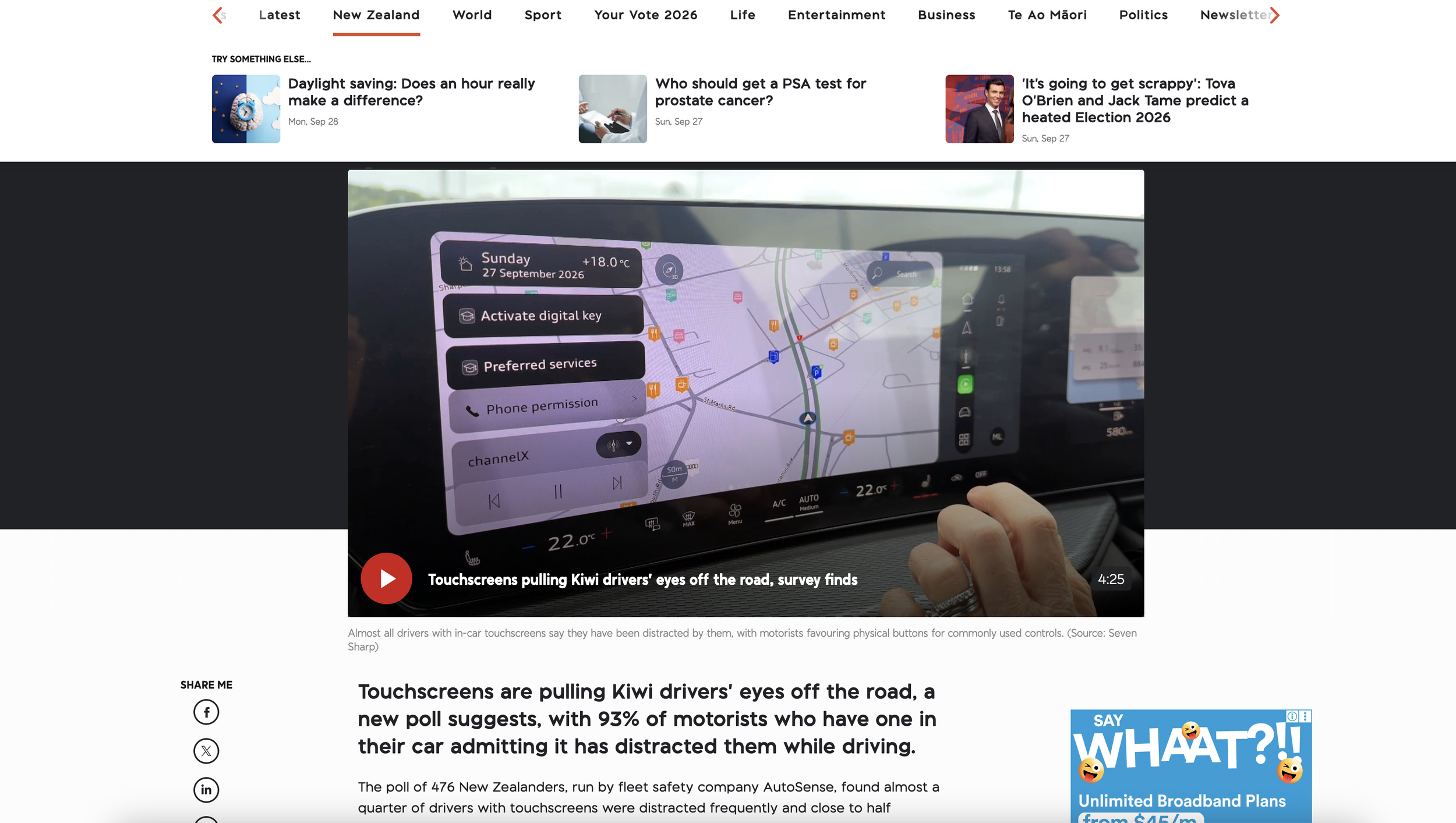
Findings worth publishing. The poll gathered enough responses across both markets to produce insights AutoSense could confidently put their name to and the numbers were striking. AutoSense reported that touchscreens distracted 93% of the Kiwi drivers surveyed, a finding that gave the conversation about in-car technology a hard edge.
You can read the results in full on the AutoSense site: - New Zealand: Touchscreens distract 93% of Kiwi drivers surveyed Australia: New driver poll highlights the challenge of managing distraction behind the wheel. From there, the PR agency took the findings out to media, because AutoSense had something far more valuable than an ad campaign: a point of view backed by evidence, and the authority that comes with it. And the media responded. TVNZ Seven Sharp picked up story and ran with it - watch it here - www.1news.co.nz/2026/09/30/touchscreens-pulling-kiwi-drivers-eyes-off-the-road-survey/.
This kind of national coverage is worth every penny spent on the campaign 100X.
Four things you can take from this:
You don't need a research project to apply the thinking.
1. Know why you're publishing, not just what. The poll wasn't content for the sake of content. It existed to produce something useful. Start with the outcome and work backwards.
2. Match the channel to the mindset. The same message rarely works identically on Instagram and LinkedIn. Adjust the angle.
3. Make participation easy. Whether it's a poll, an enquiry form or a newsletter sign-up, every unnecessary field and extra condition costs you responses.
4. Use specialists, and make them talk to each other. The best result here came from all the partners doing their own job well and handing over cleanly.
When marketing is done well, the impact compounds
A poll became data. Data became insight. Insight became media coverage, credibility and a genuine contribution to a road safety conversation in two countries. None of that happens by accident, and - this is the part we most want small businesses and not-for-profits to hear - none of it needs to cost the earth. It needs a clear objective, the right people in the right lanes, and someone paying attention while it's live.
Thinking about a campaign like this? If you've got a survey, a launch, an event or a piece of research that deserves a real audience, we'd love to hear about it. Korio works as your marketing business partner and we're very happy sharing the table with your other suppliers. Get in touch for a chat about your next campaign.