
Your website isn't a marketing plan (and that's why it isn't bringing in business)
"If you build it, they will come."
It's a great movie quote, but it's terrible marketing advice.
One of the biggest misconceptions we see is the belief that launching a website will automatically bring in customers. Businesses invest time, money and energy into creating a beautiful website, hit the "Publish" button... and then wait. And wait.
A few weeks later, they're wondering why enquiries haven't increased, why sales haven't improved, or why website traffic is still sitting stubbornly low. That's usually when we get the call:
"The website isn't working."
Our first question is always, "What do you mean by not working? Is the website down?"
The answer is almost always, "No, it's online... it's just not bringing in any business."
And that's the important distinction. The website is working exactly as it was built to work. What's missing is the marketing needed to get the right people there in the first place.
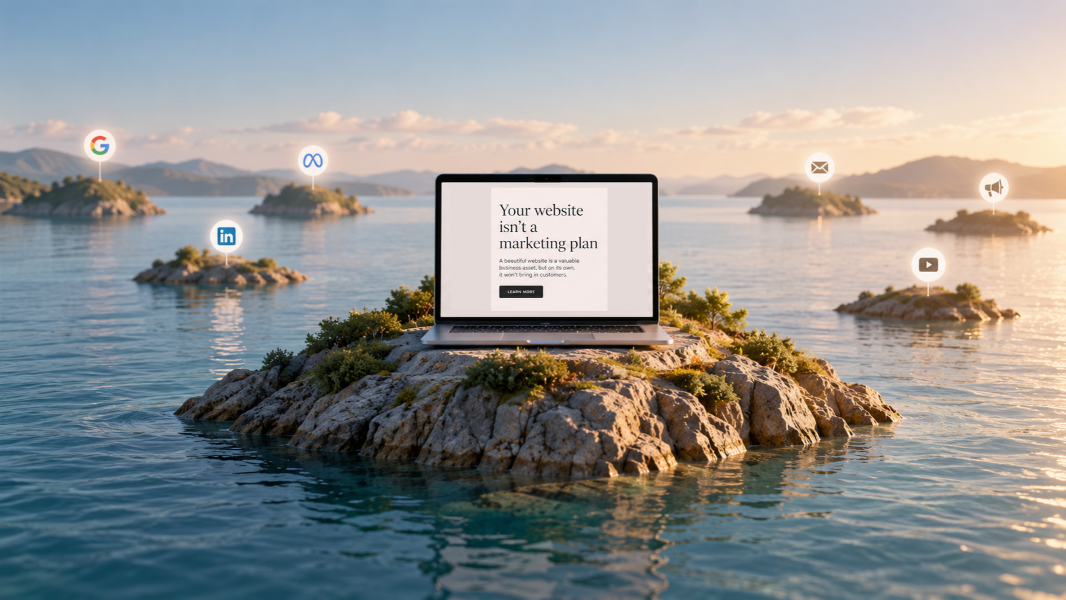
The truth is, a website is an incredibly valuable business asset, but on its own, it's not a marketing strategy.
Think of your website as your shopfront
Imagine opening a beautiful new retail store.
You've painted the walls, installed gorgeous displays, stocked the shelves and put up an impressive sign.
Now imagine building that store in the middle of nowhere.
No roads.
No advertising.
No social media.
No local newspaper.
No signs pointing people in the right direction.
How many customers are going to find you?
A website works exactly the same way.
Your website is where people come once they've discovered you. It's where they learn more, build trust, and hopefully take action.
But something has to get them there first.
A website has a job. Marketing has a different one.
Your website's role is to convert visitors into customers. Marketing's role is to create those visitors in the first place.
They're two different pieces of the same puzzle.
A well-designed website should:
Clearly explain what you do so visitors instantly understand who you are, what you offer and how you can help.
Build credibility and trust through professional design, testimonials, case studies, credentials and content that demonstrates your expertise.
Answer the questions your customers are already asking so they have the confidence to choose you over your competitors.
Make it easy for people to take action whether that's making an enquiry, booking an appointment, requesting a quote or purchasing a product.
Guide visitors towards the next step with clear calls to action that encourage them to become a customer rather than simply leave the site.
Your marketing activities are what bring people through the door.
That might include:
Search Engine Optimisation (SEO) and Generative Engine Optimisation (GEO) so people can find you when they're actively searching. SEO helps your website appear in traditional search engines like Google, while GEO helps your content be referenced by AI-powered tools such as ChatGPT, Google AI Overviews, Gemini, Perplexity and Claude.
Google Ads to put your business in front of customers who are ready to buy or enquire.
Social media marketing and advertising to build awareness, engage your audience and drive traffic back to your website.
Email marketing to stay connected with existing customers, nurture new leads and encourage repeat business.
Regular blog content that answers common questions, demonstrates your expertise and improves your visibility in search and AI results.
Networking and community involvement to build genuine relationships and generate referrals through local connections.
Public relations to increase your visibility through media coverage, industry publications and community stories.
Strategic partnerships with complementary businesses that can introduce your services to new audiences.
Printed marketing such as brochures, signage, flyers and business cards that reinforce your brand offline.
Video content that showcases your products, services, team and expertise in an engaging and highly shareable format.
Referral programmes that encourage satisfied customers to recommend your business to friends, family and colleagues.
Without these activities, even the best website can sit quietly in the background. A great website is your best salesperson, but it still needs people walking through the door before it can do its job.
Websites need fuel
A website is a bit like a car.
Buying the car is only the beginning. You still need fuel, servicing, insurance, registration and maintenance if you want it to keep performing.
Websites are no different.
Many businesses budget for the website build but forget to budget for the ongoing marketing that actually drives results.
That's often where expectations and reality start to drift apart.
Why "Set and Forget" Doesn't Work
Google isn't standing still.
And your competitors certainly isn’t either.
Customer expectations change.
Search habits evolve.
New content appears every day.
A website that's left untouched for months, or years, gradually becomes less effective.
Regular updates signal to both your visitors and search engines that your business is active and relevant.
That doesn't necessarily mean redesigning your website every year.
It means continuing to invest in activities that keep people finding and engaging with your business.
Build the website... then build the traffic
One of the best ways to approach a new website project is to think beyond launch day.
Instead of asking:
"How much will my website cost?"
Also ask:
How will people discover it?
What content will we create?
How will we measure success?
What marketing activities can we commit to each month?
What's our realistic budget for ongoing promotion?
These questions often have a bigger impact on business growth than the website itself.
Marketing isn't always expensive
None of this needs to cost the earth. Effective marketing isn't always about having the biggest budget.
It's about having a consistent plan.
A simple monthly routine of publishing useful content, improving your SEO and GEO, sending newsletters, posting with purpose on social media and keeping your website updated can make a significant difference over time.
Consistency almost always beats occasional bursts of activity.
Think long term
Launching a website shouldn't be viewed as the finish line.
It's the starting point.
A great website gives your marketing somewhere meaningful to send people. Your marketing gives your website a reason to exist.
One without the other rarely delivers the results businesses are hoping for.
How Korio can help
At Korio, we don't just build websites, we help businesses think about what happens next.
Whether it's developing a practical marketing plan, creating content that works, improving your search visibility or helping you make the most of your budget, we're here to become your virtual business partner.
Because creative design, words that work and smart behind-the-scenes stuff only deliver real value when people actually find them.
A website is an investment.
A marketing plan is what helps that investment pay off.